


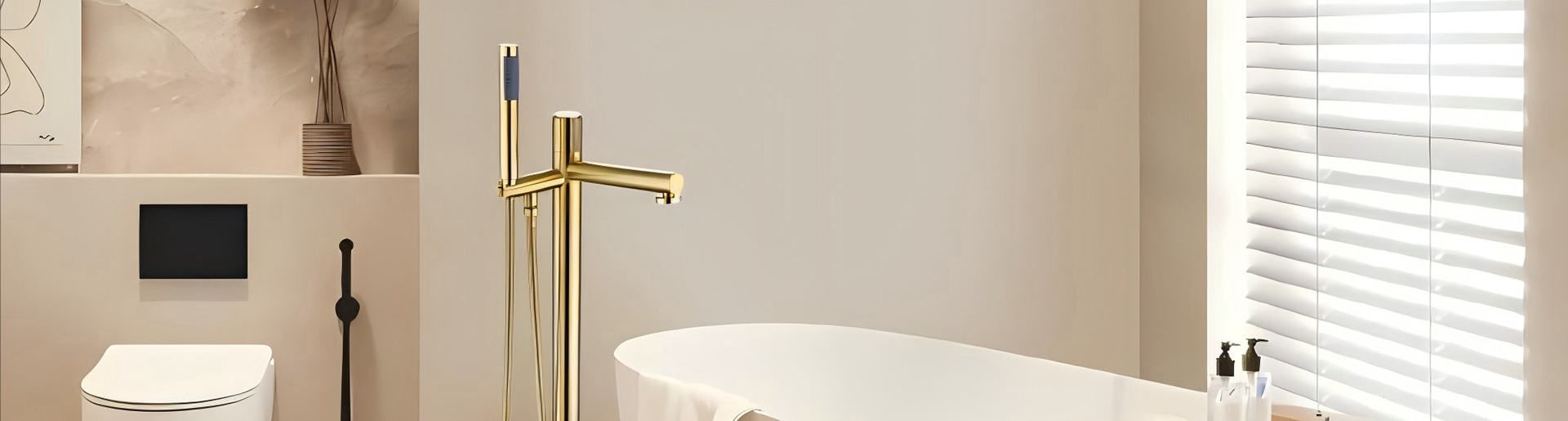
How Do Buyers Match Faucets With Basins?
Successful faucet and basin matching depends on mounting format, spout reach, outlet height, basin depth, water angle, and available installation space. Style and finish create the visual combination, but dimensions determine whether water lands near the drain, remains inside the bowl, and provides comfortable clearance for daily use.
Table of Contents
Start With the Basin Installation Type
Countertop vessel basins generally need a tall deck-mounted faucet or a wall-mounted model. Undermount and inset basins usually work with standard-height faucets installed on the countertop or sink deck. Wall-hung basins may provide prepared tap holes or require a separate wall valve.
The number of openings also limits faucet selection. A one-hole basin cannot accept a traditional three-piece widespread faucet without modification. A three-hole basin can sometimes use a single-hole model with a deck plate, provided the plate covers all openings and the mounting area is flat.
Measure Where the Water Will Land
Spout reach describes the horizontal distance from the faucet centerline to the outlet. It should direct water into the usable center area of the bowl, preferably near the drain rather than against a side wall.
When the reach is too short, users may wash their hands close to the back of the basin. Water can collect around the faucet base or splash against the rear wall. Excessive reach moves the stream toward the front edge and increases the risk of water escaping from shallow bowls.
The water angle must also be considered. Two faucets with identical spout reach can deliver water to different locations when their aerators point at different angles.
Balance Outlet Height and Basin Depth
A high outlet creates more hand clearance but increases the distance water falls before reaching the bowl. On a shallow basin, this can cause splashing. A lower outlet provides controlled delivery but may feel cramped when the bowl edge is high.
The selected bathroom basin faucet should be evaluated with water running at the intended flow rate. Dry dimensional checks cannot fully show how the stream interacts with the basin shape.
Rounded bowls, flat-bottom basins, and narrow rectangular sinks respond differently. Water striking a sloped surface may move smoothly toward the drain, while water hitting a flat wall can rebound outward.
Check the Mounting Area
The deck must provide enough flat space for the faucet base, gasket, and mounting hardware. Curved or uneven surfaces may prevent the gasket from sealing correctly.
Buyers should verify:
Mounting-hole diameter and quantity
Countertop or basin thickness
Clearance behind the faucet
Space below for hoses and fixing nuts
Handle movement near the wall
Distance between faucet and basin edge
Drain and overflow positions
Wall-mounted faucets require additional coordination because valve depth and outlet position are fixed before the wall is completed.
Coordinate Style Without Ignoring Maintenance
Finish, handle shape, and spout profile should relate to the basin design and surrounding hardware. A large decorative faucet may overpower a compact washbasin, while a very small model can look misplaced on a broad vanity.
Cleaning access should remain around the faucet base and behind the handles. Tight gaps collect water and residue, increasing maintenance work in hotels, apartments, and public washrooms.
Approve the Pair Before Bulk Production
A sanitary ware wholesale supplier should not rely only on standard product dimensions when coordinating a complete bathroom collection. The faucet and basin need to be reviewed as one functional unit.
Aidier can evaluate installation drawings, outlet position, mounting components, water flow, and finish combinations before order confirmation. Testing an approved faucet with the intended basin helps identify splashing, limited hand clearance, or mounting interference while adjustments are still practical. Correct matching supports easier installation and a more consistent user experience across the finished bathroom.